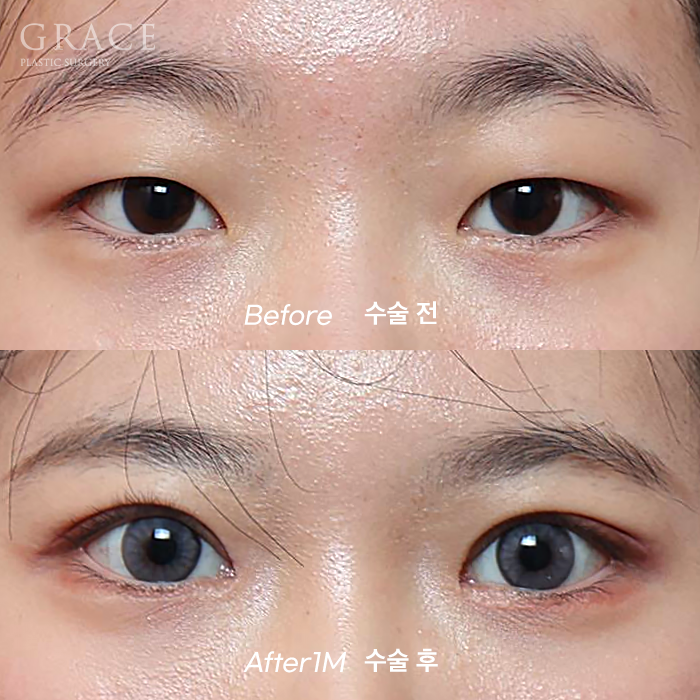
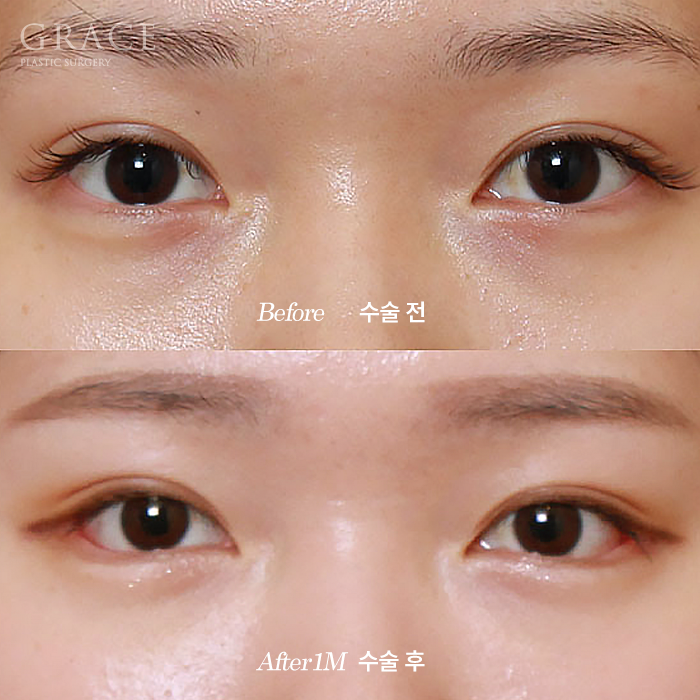
Not just going big, but a natural transformation with a 1:1 custom slit that suits you.
We complete a customized canthoplasty tailored to each individual's eyes with a meticulous design that considers the distance between the eyes, the angle of the outer corners, and the ratio of the Mongolian fold. This procedure improves stuffy-looking eyes with closed inner or outer corners into a refreshed and open look by adjusting the horizontal and vertical length or the angle of the outer corners of the eyes.
Within 30 minutes
Local Anesthesia
2 sessions
Dual Canthoplasty: None
Epicanthoplasty (Inner): After 3 days
1 week


Lowering the Outer Corners and the 'U-shaped' Deformity Complication
The outer corners of the eyes are firmly fixed by the Lateral Canthal Ligament.
Therefore, surgery to lower the eye corners typically involves incising the existing ligament and
fixing only the lower eyelid to a new position.
In this process, if the fixation points of the upper and lower eyelids differ,
the mucous membrane and skin may meet directly,
resulting in a 'U-shaped' (D-shaped) deformity.
Dual Canthoplasty is an effective way to prevent these issues.

Dual Canthoplasty: Naturally correcting the angle and line of the eye corners simultaneously without re-adhesion.
Securely lowers the lower eyelid to broaden the eye angle.
Gently releases the adhesion (joined area) between the upper and lower eyelids.
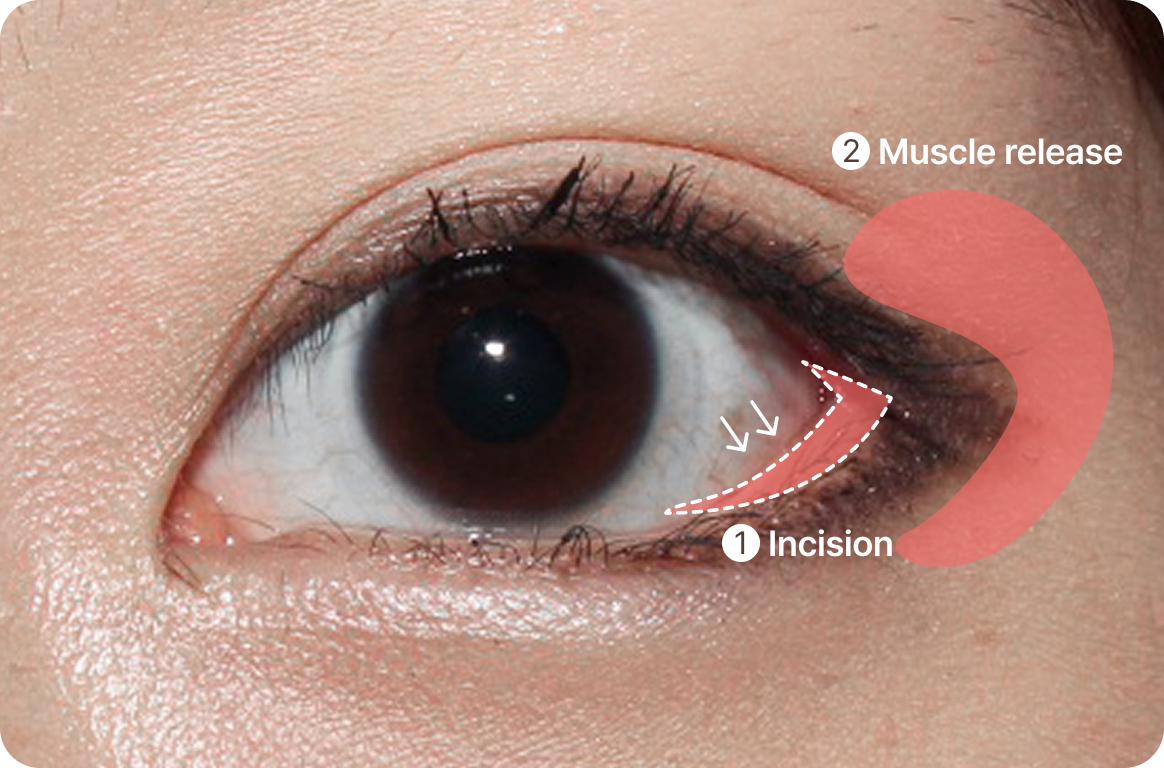
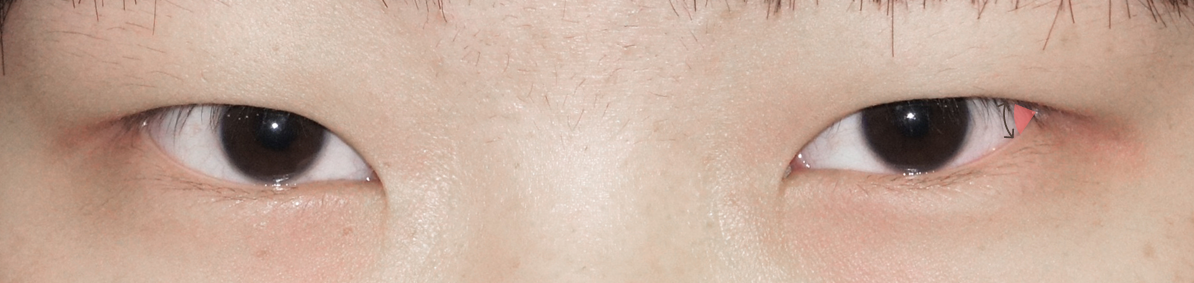

Lateral Canthoplasty
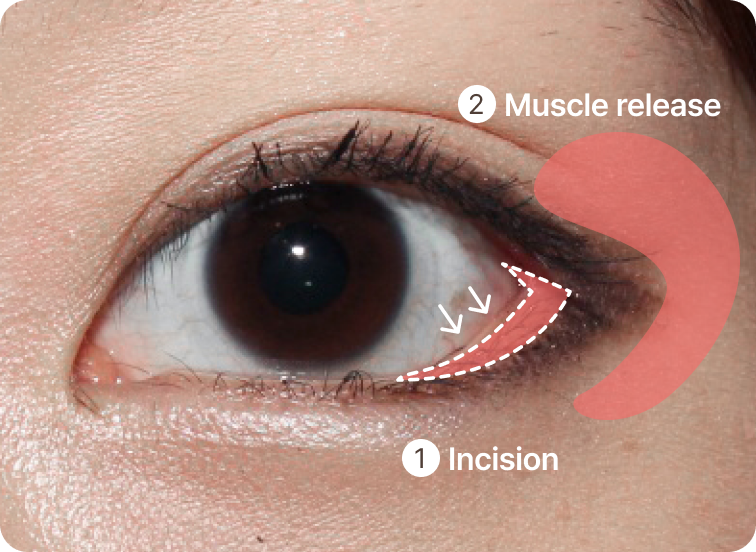
Dual Canthoplasty
(Lateral Canthoplasty
+ Lower Eyelid Canthoplasty)
The opened area does not re-adhere, ensuring a lasting and natural-looking eye shape.
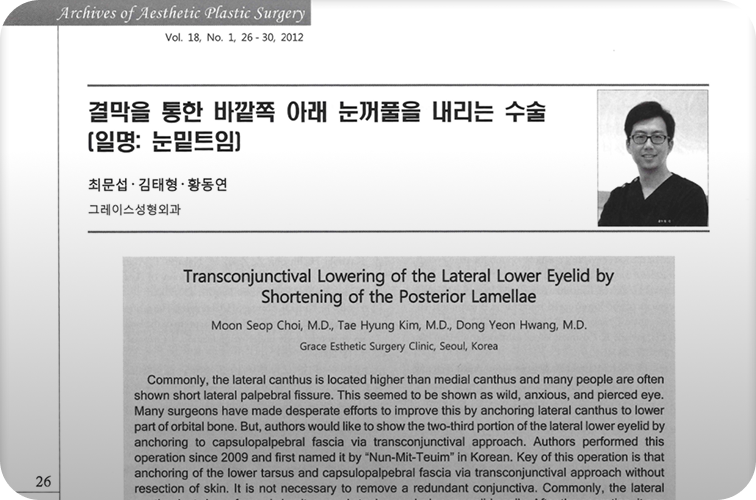
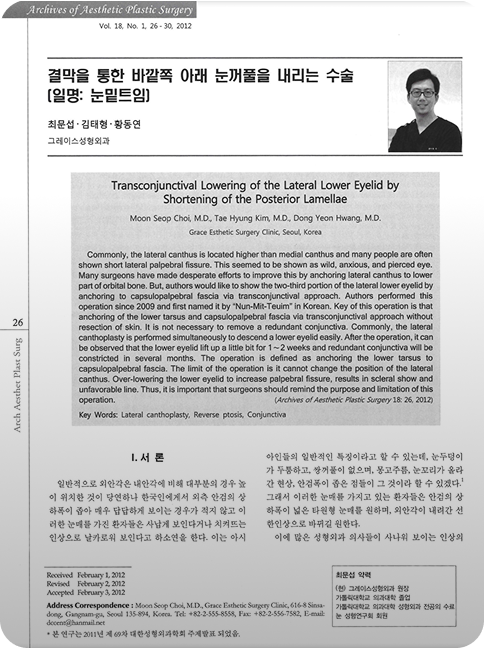
In 2009, Dr. Moon-seop Choi was the first to introduce the term "Under-eye Canthoplasty" in Korea.
As it became an essential procedure to perform alongside Lateral Canthoplasty, he coined the term
"Dual Canthoplasty" around 2010.
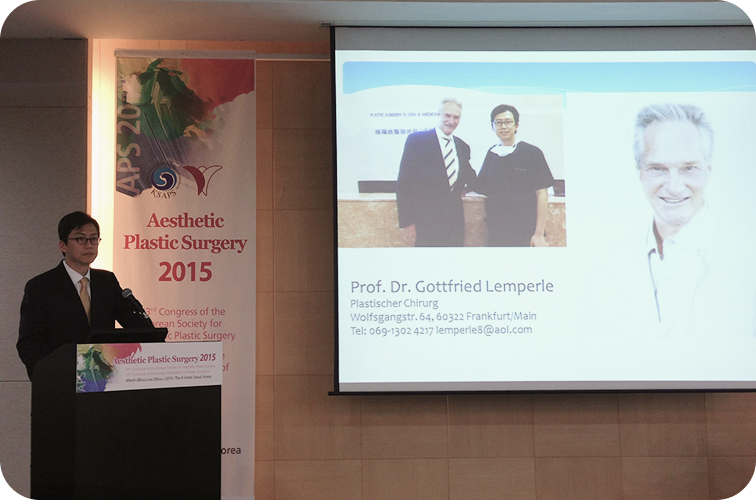
Since then, he has delivered numerous lectures at plastic surgery conferences. In 2012, he presented his work to the Korean Society for Aesthetic Plastic Surgery under the title:
"Lowering the Outer Lower Eyelid via Conjunctiva (A.K.A. Under-eye Canthoplasty)."


The incision ends deep inside the lower eyelid,
making the visible scar almost non-existent.
By preserving the muscle, the natural "Aegyo-sal" (under-eye roll) is maintained, ensuring a soft inner corner.
This is especially suitable for those worried about losing their under-eye volume after surgery.
Instead of an unnaturally wide-open look,
we achieve a natural expansion that respects the original shape of your eyes.
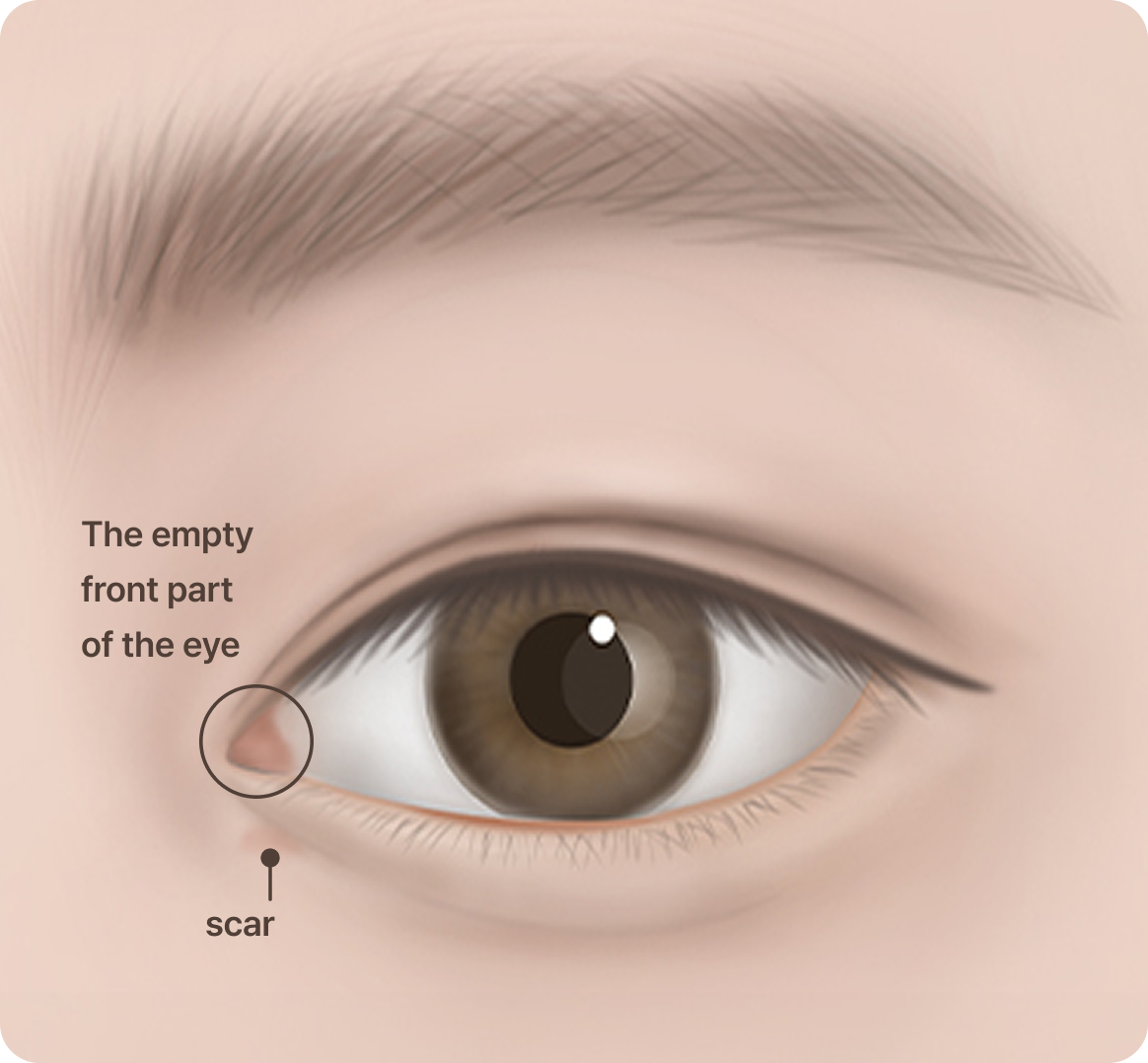

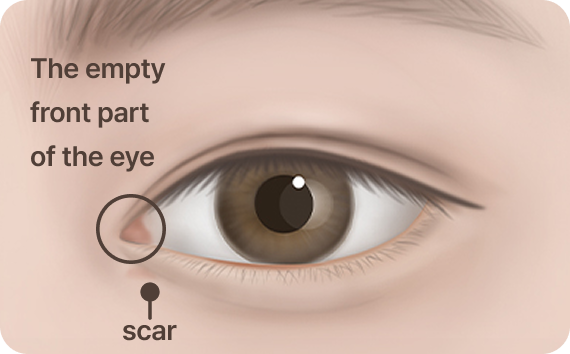


Epicanthoplasty design tailored to each individual's eye structure


Repositioning of the Mongolian fold after micro-incision


No incision of the orbicularis oculi muscle and no muscle damage, maintaining aegyo-sal volume and soft expression in the front area

Grace sets clear standards for diagnosis.
We do not exaggerate results or recommend excessive procedures,
and we suggest the right direction
based on each patient's condition and needs.

From consultation, design, surgery, to follow-up care,
the entire process is carried out under the sole responsibility of the director.
Since neither the doctor nor the process changes, responsibility is never divided.
The person who started will be with you until the end.

Through continuous research and academic presentations,
we reflect the latest knowledge in clinical practice.
All procedures are performed based on verified evidence and accumulated experience,
providing more precise and safer unrivaled technical expertise.
Expanding excessively to the red flesh (caruncle) can make the eyes look too close together. Grace adjusts the ratio so that the red portion of the inner corner is visible to a proper extent, completing a natural and refreshed eye shape.
The procedure is performed using a micro-incision method, so scars are barely visible. It recovers naturally and smoothly after surgery.
Yes, it is possible. We proceed with a customized combination based on the eye shape and skin condition, designing the most harmonious look by comprehensively considering the length, angle, and balance of the eyes.